Algorithmic Checks That Back Fair Play Promises in Digital Card and Wheel Games
Viktor Krüger · Aug 11, 2026
Algorithmic Checks That Back Fair Play Promises in Digital Card and Wheel Games
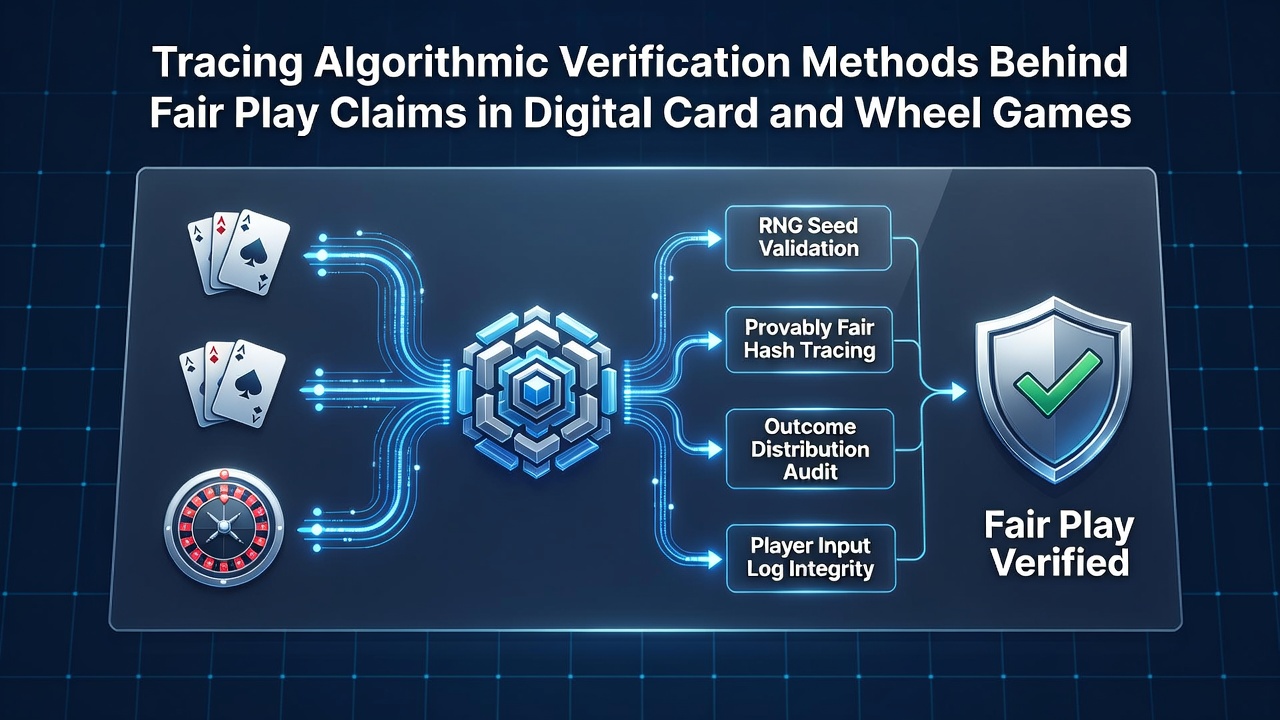
Digital card games and wheel-based titles rely on complex algorithms to deliver outcomes that match stated probabilities, and verification methods trace every step from random number generation through final display. Researchers track these systems by examining how seeds initialize, how cryptographic functions transform those seeds, and how independent labs test the resulting sequences against mathematical expectations.
Core Components of Random Number Generation
Most platforms start with hardware or software random number generators that produce long strings of values, then feed those strings into game-specific logic such as card shuffling routines or simulated wheel spins. Observers note that cryptographic hash functions like SHA-256 often wrap the raw output, creating deterministic yet unpredictable sequences that auditors can replay during certification. Data from testing laboratories shows that effective generators pass suites such as NIST SP 800-22, which includes checks for frequency, runs, and serial correlation across millions of draws.
Verification Techniques Applied to Card Games
In poker and blackjack titles the algorithm must replicate a fair 52-card deck without repetition or bias. Engineers implement Fisher-Yates shuffle variants driven by the random stream, and verification teams reconstruct each shuffle from the recorded seed and timestamp. One documented process involves supplying a known seed to the live system, recording the resulting deck order, then comparing that order against an independent implementation of the same algorithm. Studies published in 2024 confirmed that discrepancies appear within the first 10,000 simulated deals when implementation errors exist, allowing rapid isolation of faults.
Additional layers include hash-chain commitments published before play begins, so players or regulators can later confirm that the deck was not altered mid-round. In August 2026 several North American operators adopted public ledgers that store these commitments, enabling real-time cross-checks without exposing future cards.
Wheel Game Verification Methods
Roulette and similar wheel titles simulate ball drop and segment selection through continuous random values mapped to physical parameters such as angular velocity and friction coefficients. Verification requires statistical analysis of thousands of spins to confirm that each pocket receives hits within expected variance. Engineers compare output distributions against chi-square and Kolmogorov-Smirnov tests; regulators accept results only when p-values fall within pre-defined tolerance bands.

Some developers incorporate physical random sources, such as atmospheric noise or quantum optical effects, to seed the simulation. Reports from Gaming Laboratories International detail how these hybrid systems undergo both digital and hardware audits, with separate evaluation of sensor calibration and entropy extraction routines. Data collected across multiple jurisdictions indicates that hybrid sources reduce detectable patterns by orders of magnitude compared with purely algorithmic generators.
Third-Party Certification and Ongoing Monitoring
Independent laboratories conduct initial certification then perform periodic re-testing after software updates. The process includes source-code review, live penetration attempts, and long-term statistical monitoring of production traffic. According to documentation from the Nevada Gaming Control Board, certified systems must demonstrate stability across at least 10 million game cycles before receiving approval stamps. Subsequent audits occur quarterly, with automated alerts triggered when outcome distributions drift beyond calibrated thresholds.
Academic teams have contributed by publishing open-source verification tools that regulators and operators can run against live feeds. A 2025 paper from researchers at the University of Waterloo outlined a lightweight protocol that samples game logs in real time and flags deviations within minutes, reducing the window during which biased play could occur.
Emerging Practices in August 2026
By August 2026 several platforms integrated zero-knowledge proofs that let auditors confirm fairness properties without revealing proprietary code. These proofs allow a prover to demonstrate that a shuffle algorithm satisfies uniformity constraints while keeping internal state hidden. Early field data from Australian testing facilities suggests verification time drops by roughly 40 percent when zero-knowledge methods replace traditional code walkthroughs.
Conclusion
Algorithmic verification combines cryptographic primitives, statistical testing, and independent oversight to substantiate fair play claims in digital card and wheel environments. Continuous monitoring, public commitments, and evolving proof techniques keep these systems aligned with declared probabilities across changing regulatory landscapes.